
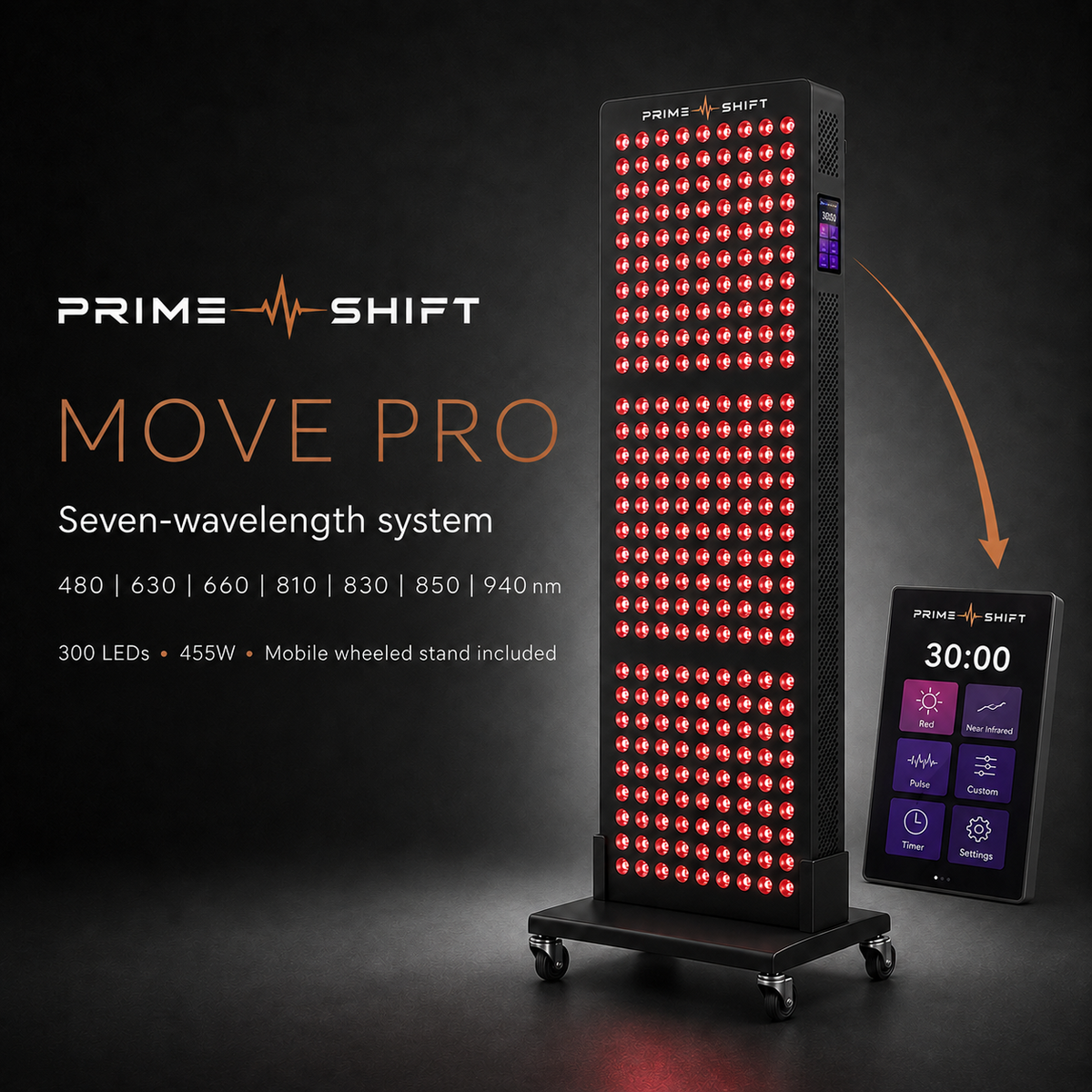
Can light help your muscles recover? Research suggests it can under specific treatment conditions—but the details matter.
If you train regularly, you have probably seen red light panels appearing in gyms and recovery spaces. At Prime Shift, we believe understanding the evidence should be part of choosing your equipment. Here is what the science tells us, what remains uncertain, and how to read recovery claims with confidence.
What is photobiomodulation?
Photobiomodulation, often shortened to PBM, uses light to influence biological processes. Red and near-infrared wavelengths are commonly studied. Red light is visible; near-infrared light sits beyond the visible spectrum.
One proposed mechanism involves mitochondria, the structures involved in producing ATP—the energy-carrying molecule cells use. Light absorption by mitochondrial components such as cytochrome c oxidase may affect cellular respiration and signalling. Researchers are also investigating other pathways.
This is a biological explanation for why light might have an effect. It does not mean that a session will automatically increase your energy, improve your workout or produce the same response in everyone. Read the mechanisms review by Hamblin.
What does the muscle-recovery research show?
A 2025 systematic review examined 14 controlled studies of light therapy for delayed-onset muscle soreness (DOMS). Four studies supplied enough comparable data for the pooled analysis.
- Soreness: the pooled results showed lower pain scores than placebo at 72 and 96 hours after DOMS was induced.
- Strength: muscle-strength outcomes were better than placebo at 24 and 48 hours.
- Treatment: studies used wavelengths from 660 to 950 nm, applied to one to six points on affected muscles.
These findings are encouraging, but the pooled evidence came from relatively few studies. Protocols differed, and some included trials found no significant benefit. A result measured at 72 hours is an assessment time, not a promise that every user will recover within three days. Read the 2025 review by Tsou and colleagues.
Why the device and dose matter
“Red light” describes a broad category. To understand a treatment, you need more than the colour of the LEDs or a session timer. Useful details include:
- Wavelength: the light used, expressed in nanometres (nm).
- Irradiance: the light power reaching a surface per unit area, often expressed in mW/cm².
- Exposure time and distance: how long the session lasts and where you sit or stand relative to the device.
- Coverage and timing: which area is exposed and when treatment occurs relative to exercise.
For a constant irradiance, energy delivered per unit area depends on both intensity and duration. That is why copying a session length from a different device does not necessarily reproduce its dose. A measurement at the skin also does not tell you exactly how much light reaches a deeper muscle.
Laboratory research describes dose-dependent responses, so more exposure should not be assumed to give better results. Follow the instructions for your particular device rather than increasing time or moving closer in pursuit of a stronger effect.
What this means for a home panel
The studies discussed here do not establish clinical results for Prime Shift MOVE panels. A home panel may differ from a research device in output, coverage, treatment distance and protocol. Matching a wavelength alone is not enough to demonstrate equivalent outcomes.
When comparing equipment, ask for clear specifications and usage guidance. Consider the space you have, the area you want to cover and how comfortably the panel fits into your routine. For more practical guidance, read our guide to choosing a red light therapy panel for home.
Build a routine you can sustain
Keep your expectations specific and realistic. If you use a panel, follow its guidance on session length, distance and eye protection. Keep track of your routine instead of changing several things at once. Personal observations can help you assess your experience, but they are not a controlled test of effectiveness.
Recovery still deserves attention beyond equipment: make room for rest, sensible training progression and adequate food and fluids. Persistent or unusual pain should be assessed rather than treated as ordinary workout soreness. If you take medication that increases light sensitivity or have a relevant medical condition, check suitability with a healthcare professional.
Explore Prime Shift MOVE
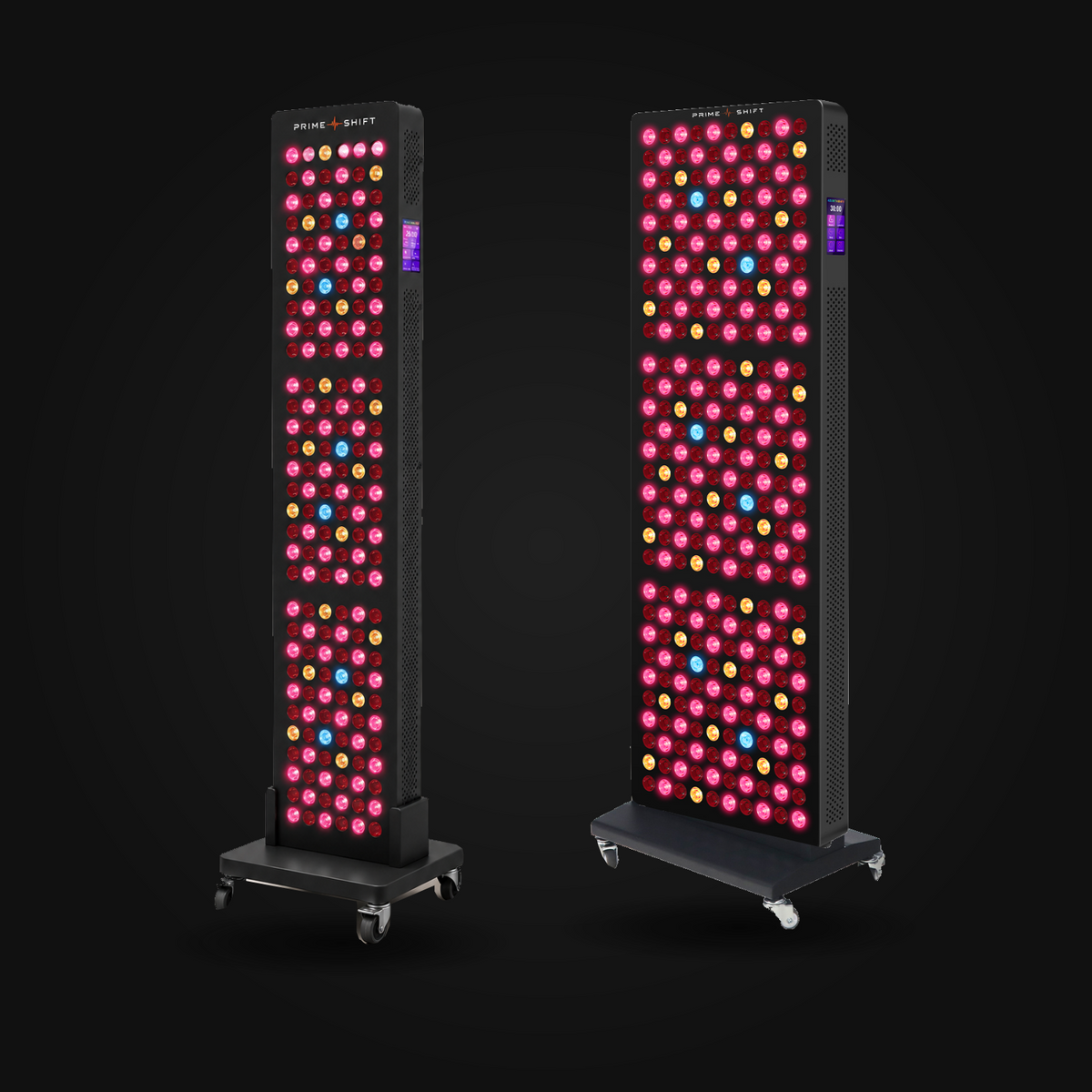
Compare the MOVE Digital, MOVE Plus and MOVE Pro to find the format that suits your space and routine.
Prime Shift. Own Your Next Prime.
Research references
- Tsou YA, Chang NJ, Chang WD. Effects of Photomodulation Therapy for Delayed Onset Muscle Soreness: A Systematic Review and Meta-Analysis. Journal of Functional Morphology and Kinesiology. 2025;10(3):277. doi:10.3390/jfmk10030277.
- Hamblin MR. Mechanisms and Mitochondrial Redox Signaling in Photobiomodulation. Photochemistry and Photobiology. 2018;94(2):199–212. doi:10.1111/php.12864.
This article is for general education and is not a personalised treatment plan.

Leave a comment
This site is protected by hCaptcha and the hCaptcha Privacy Policy and Terms of Service apply.